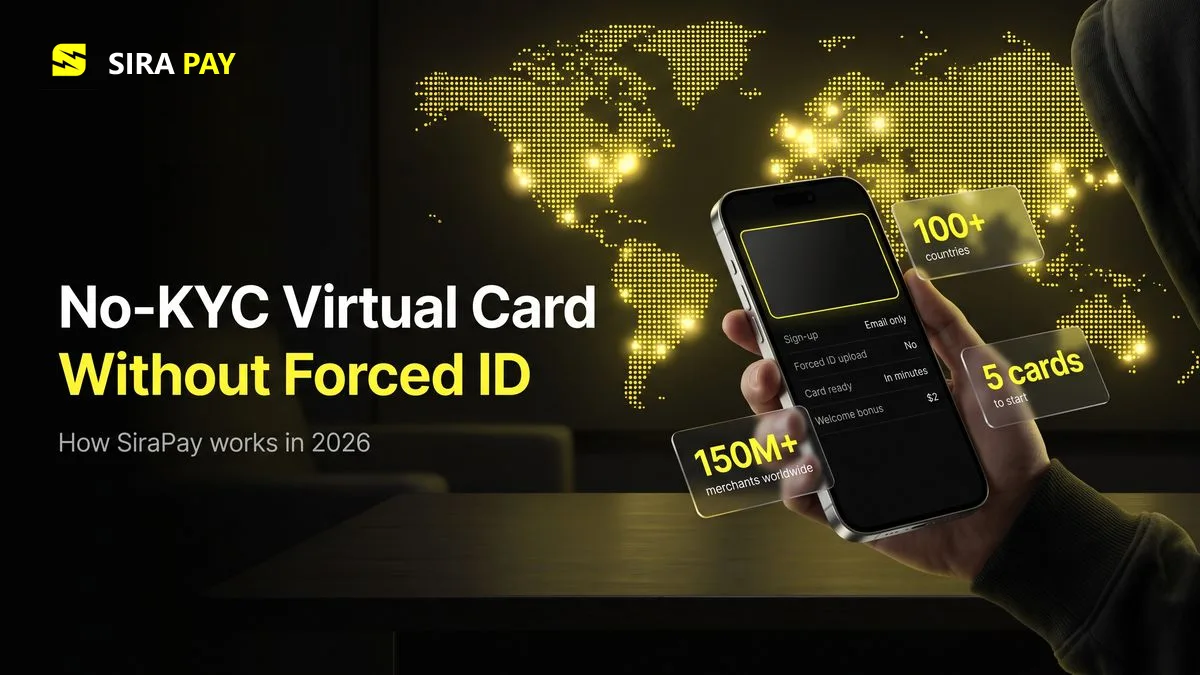
Search for a no-KYC virtual card and you will find dozens of cards selling privacy. Open the sign-up screen and many of them ask for the same things a bank does: a passport photo, a selfie, a face scan, sometimes your tax number. The word "privacy" is on the landing page. The KYC is in the app.
This guide explains what no forced KYC really means, how SiraPay works step by step, and how the best-known names compare, with a source for every claim. Facts were checked on October 24, 2026. Card policies change, so check again before you sign up anywhere.
Skip the bank hassle — get a privacy-first virtual card in minutes, no forced KYC.🎁 Use code WELCOME23 for 70% off the Monthly Card, or WELCOME07 for 33% off the Yearly Card.
Get Your Virtual Card →What "No Forced KYC" Actually Means
KYC (know your customer) is the identity check banks and payment apps run: a government ID, a selfie or video, proof of address. A card with no forced KYC lets you open an account and spend without that check as the entry ticket.
The difference is when a provider asks for ID. A KYC card asks every user on day one, before you can spend a cent. SiraPay's privacy policy says standard onboarding needs no facial verification, no biometrics and no government ID upload, and its compliance page explains how it follows anti-money-laundering rules. ID is not the door you have to walk through.
"Privacy-First" in the Ad, Passport Scan at Step One
Call it privacy-washing: a brand sells privacy, but the sign-up collects the same documents your bank holds, and often hands them to an outside ID-check company. Your data is then stored in two places instead of one. That is the opposite of private.
Here is how the names people compare most often handle identity, checked on October 24, 2026:
| Card | ID check to use it? |
|---|---|
| SolCardCrypto card, quick virtual issuance | Partly. Since a June 2026 update, new Visa cards need identity verification (its Full Access tier). The Mastercard virtual card is still issued without KYC, but has no Apple Pay or Google Pay. (The Defiant) |
| Privacy.com"Privacy" is in the name | Yes. Its help centre says federal law requires it to verify your name, address and date of birth, and it may ask for a driver's licence. Users also report SSN and selfie checks. (Privacy.com help centre) |
| RedotPayCrypto card for global spending | Yes. ID document plus a face scan before the core features open. (CryptoSlate review) |
| WiseMulti-currency account and card | Yes. Every customer is verified at some stage, with an ID photo and a live photo of your face. (Wise help centre) |
| RevolutDigital banking app and cards | Yes. You must verify your identity to top up and use the account, and your selfie is matched to your ID. (Revolut community) |
| Halo (Halocard)Privacy virtual cards | Yes. Its founder says an identity check is legally required. Its privacy means masking your bank details from merchants, not skipping ID. (Privacy Guides forum) |
| SiraPayPrivacy-first virtual card | No. No ID upload, no selfie and no face scan to sign up and spend. |
SolCard: no-KYC, until it isn't
SolCard built its name as a crypto card you could get in seconds. After a June 2026 update, new Visa cards are only issued to verified users, with its banking partner as the stated reason, and people with frozen Visa cards were told to verify or withdraw. The Mastercard virtual card is still issued without KYC, but it doesn't work with Apple Pay or Google Pay. If you choose SolCard for privacy, check which card you are getting.
Privacy.com: privacy in the name, ID in the sign-up
Privacy.com is a good tool for masking your US bank card from merchants. But its own help centre says it must verify your name, address and date of birth, and it may ask for a driver's licence. Users on privacy forums report SSN requests and selfie checks run by outside ID companies. It is also built for US residents, which is why so many people search for a Privacy.com alternative.
RedotPay, Wise and Revolut: full KYC by design
These three don't pretend otherwise, and they are solid products for people who are fine with KYC. RedotPay asks for an ID document and a face scan before its core features open. Wise says every customer is verified at some stage, with an ID photo and a live photo. Revolut says you must verify your identity to top up and use the account. If what you want is no forced KYC, none of them fits.
Halo: privacy from merchants, not from ID checks
Halocard sells privacy virtual cards, and it does hide your real bank details from the shops you pay. But its founder has said publicly that an identity check is legally required to use it, and that anonymity is not what the product solves. That is a fair answer, but it means Halo is a KYC card with merchant masking, not a no-KYC card.
5 Checks Before You Trust a "Privacy-First" Card
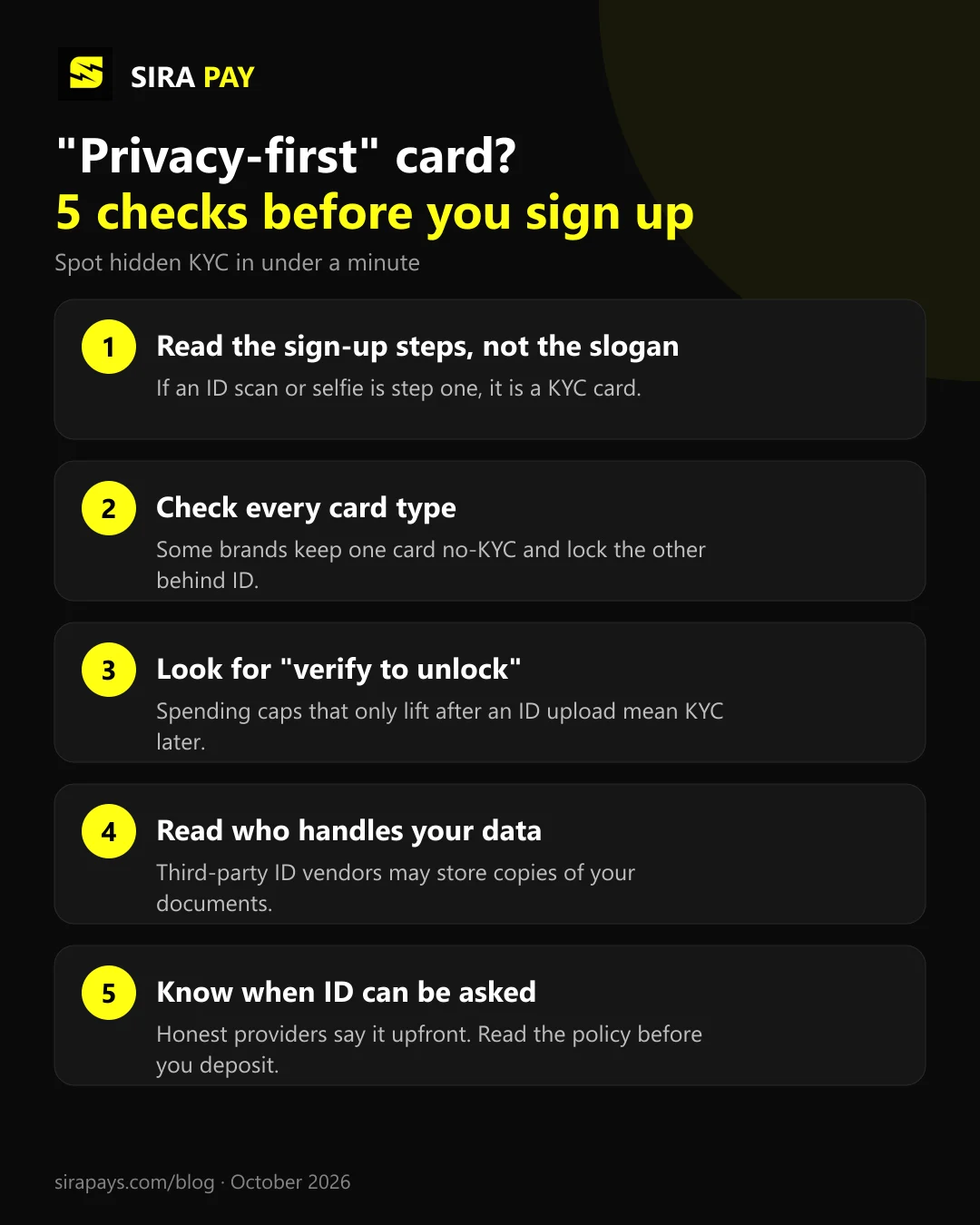
- Read the sign-up steps, not the slogan. If an ID scan or selfie is step one, it is a KYC card, whatever the homepage says.
- Check every card type. Some brands keep one card no-KYC and put the other behind ID, as SolCard now does with Visa.
- Look for "verify to unlock". A spending cap that only lifts after an ID upload means KYC later instead of now.
- Read who handles your data. Third-party ID companies may store copies of your passport and face scan.
- Know when ID can be asked. Honest providers say it upfront in their policy, so read it before you deposit.
How to Get a SiraPay Card in 4 Steps
- Sign up with your email. No passport, no selfie, no face scan. New accounts get a $2 welcome bonus, and the steps to unlock it are shown in the app.
- Add funds. Top up with crypto or a supported method. Binance Pay deposits are free. All fees and limits are on the pricing page.
- Create your card. You start with 5 cards and get more when you upgrade. The card is usually ready in minutes, with a number, expiry, CVV and a US billing address.
- Pay online. Use it like any Visa at checkout. For the current card price, Check the app
What People Use It For
- ChatGPT and AI tools. There is a dedicated ChatGPT card, and code ChatGPT1 gives 60% off it.
- Streaming and software. Netflix, Spotify, Canva, design and SaaS subscriptions, each on its own card if you like.
- Ad platforms. Meta and Google Ads, where a local card often fails on international billing.
- Shopping and travel bookings. International marketplaces, Airbnb and Uber.
SiraPay already has users in 100+ countries. To see how spending works day to day, read our guide to spending online worldwide.
What SiraPay Is Not
Straight answers build more trust than slogans, so here are the limits. SiraPay is spend-only: it pays for things but doesn't receive money, so it is not a bank account or a way to get paid. No card, ours included, can guarantee every merchant will approve a payment, because the merchant and its payment processor make the final call.
Quick Answers
Is SiraPay really a no-KYC virtual card?
SiraPay has no forced KYC. You sign up with your email, with no ID upload, no selfie and no face scan in standard onboarding.
Is a no-KYC virtual card legal?
A card with light onboarding is legal when the provider works with a card-issuing bank and follows AML rules. SiraPay cards are Visa cards issued by Standard Chartered Bank.
Does SolCard require KYC?
Partly. As of October 2026, new SolCard Visa cards need identity verification, while its Mastercard virtual card is still issued without KYC.
Does Privacy.com work outside the US?
Privacy.com verifies your name, address and date of birth under US law and is built for US residents with a US bank account. If you live outside the US, a card like SiraPay that you fund yourself is the usual alternative.
Can I use a SiraPay card for ChatGPT, Netflix or ads?
Yes. SiraPay cards work at 150M+ merchants online, including AI tools, streaming and ad platforms. For ChatGPT there is a dedicated card, and code ChatGPT1 gives 60% off it. No card can guarantee approval, because the merchant makes the final call.
How many cards can I create?
You start with 5 cards, and you get more cards when you upgrade your plan. A separate card for each site keeps a leak on one site away from the rest.
Final Thoughts
"Privacy-first" should mean something before the first payment, not after a passport scan. If a card needs your ID and your face to get started, it is a KYC card with a privacy slogan. SiraPay lets you sign up with an email, spend at 150M+ merchants, with no passport and no selfie. That is what a no-KYC virtual card should look like.