
Research now runs on subscriptions. You draft with ChatGPT or Claude, write in Overleaf, polish with Grammarly, keep references in Zotero and search the literature with tools like Elicit. Every one of them bills in dollars, from abroad, every month or every year. For a PhD student in Lagos, Lahore, Dhaka or Cairo, that often means a stipend that is enough, and a local card that isn't.
This guide lists what the main tools cost in 2026, builds a realistic monthly research budget, explains why local cards fail on these sites, and covers the hardest bill of all: journal article processing charges. Prices were checked on the providers' own pages on October 30, 2026.
Skip the bank hassle — get a privacy-first virtual card in minutes, no forced KYC.🎁 Use code WELCOME23 for 70% off the Monthly Card, or WELCOME07 for 33% off the Yearly Card.
Get Your Virtual Card →What the Main Research Tools Cost in 2026
| Tool | Price |
|---|---|
| ChatGPT PlusDrafting, coding, data help | $20 a month (US list price) |
| Claude ProLong papers, careful reasoning | $20 a month (US list price) |
| Overleaf StudentLaTeX writing and collaboration | $13 a month or $98 a year |
| Grammarly ProLanguage and clarity checks | From $12 a month |
| Zotero storageReference library sync | $20 a year (2 GB) to $120 a year (unlimited) |
| Elicit ProSystematic literature reviews | $49 per month, billed yearly |
Overleaf's student plan is for students at degree-granting institutions and adds collaborators and its AI assistant, while its free plan allows one collaborator per project. Zotero's free storage is 300 MB, which a growing PDF library outgrows fast. Elicit's free Basic plan is enough for casual searching; Pro is aimed at systematic reviews. Prices exclude local taxes, which some tools add at checkout.
A Realistic Monthly Research Budget
- Lean (about $10 a month): Overleaf Student yearly ($98, about $8 a month) plus Zotero 2 GB ($20 a year). Free tiers of the AI tools.
- Standard (about $30 a month): the lean stack plus one AI assistant, ChatGPT Plus or Claude Pro, at $20 a month.
- Writing-up year (about $45 a month): add Grammarly Pro during the thesis and paper writing months, then cancel.
You rarely need two AI assistants at once. Pick the one that suits your field and switch later if needed. Our comparison of ChatGPT Free, Go and Plus helps if a cheaper plan is enough.
Why Research Tools Decline Local Cards
These tools are sold by companies in the US and Europe, so your card has to pay a foreign merchant in dollars. Many cards in emerging markets are blocked for that by default, have a low online limit, or fail the OTP step. The recurring part makes it worse: a tool that charged you fine in September can fail in October when your monthly limit is used up. If ChatGPT is the one failing, our guide to the "payment was not approved" error covers the bank-side fixes.
Five Habits for Paying Research Tools
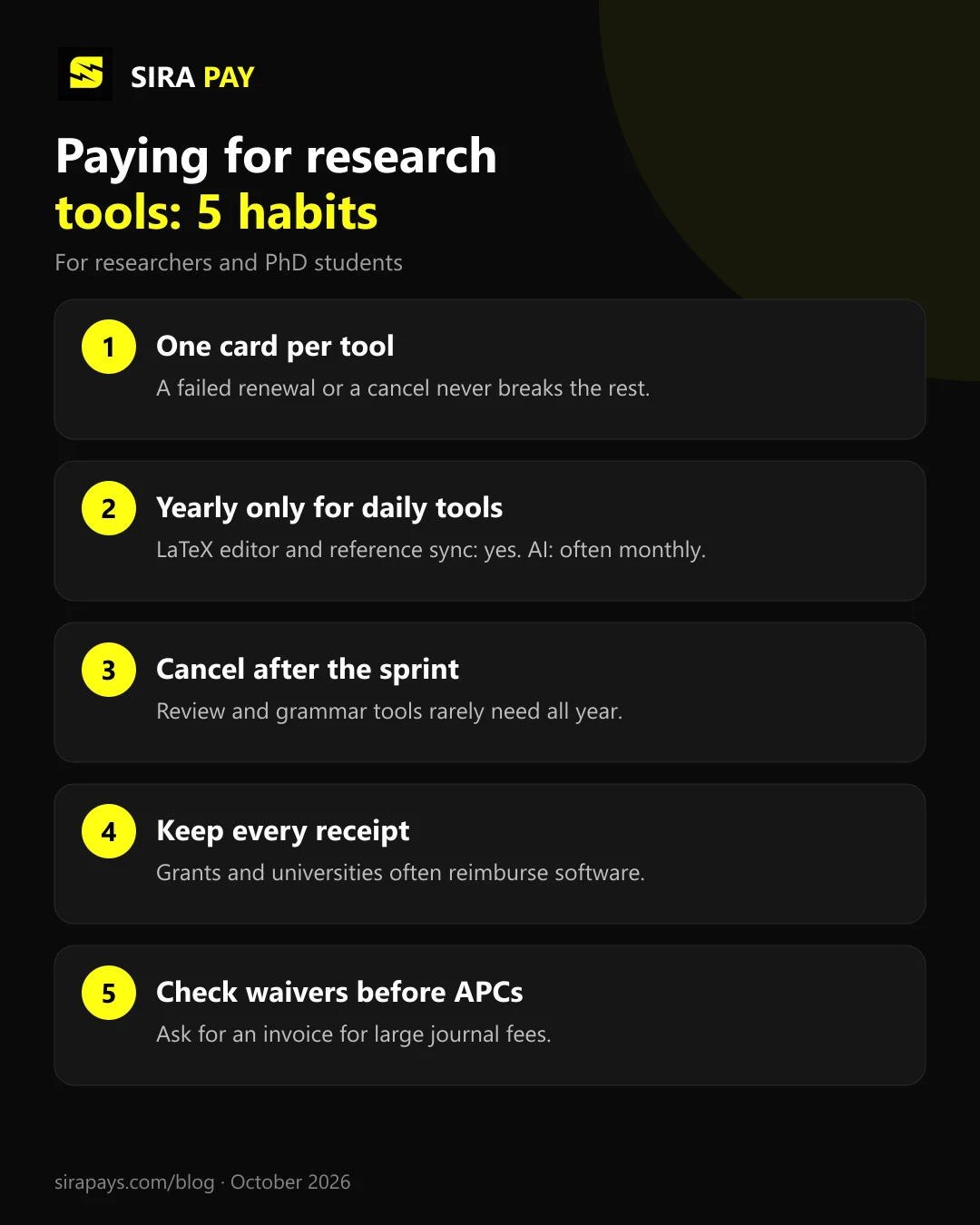
- One card per tool. If one renewal fails or you want to stop a tool, you freeze one card and nothing else breaks.
- Yearly only for daily tools. Overleaf and Zotero save money on yearly plans. AI assistants are often better monthly.
- Cancel after the sprint. Literature-review and grammar tools are often needed for a few months, not all year.
- Keep every receipt. Many universities and grants reimburse research software if you can show the invoice.
- Check waivers before any journal fee. More on that below.
Journal Fees: The Bill to Handle Differently
Article processing charges (APCs) are a different scale. Research on APCs notes that some journals charge more than $10,000, and that in regions with little research funding that money is usually not available. A survey of researchers in Argentina, Brazil, Mexico and South Africa found many use waivers, personal funds or international co-authors to pay.
- Ask for a waiver first. Many publishers discount or waive APCs for authors from low- and middle-income countries.
- Check your institution's agreements. Read-and-publish deals can cover the fee entirely.
- For large amounts, ask for an invoice that your grant or university can pay directly, rather than a personal card.
- Use a card for smaller fees such as submission or conference registration fees, where card payment is normal.
Where SiraPay Fits
SiraPay is a privacy-first virtual card for the subscription side of research. You sign up with your email, with no forced KYC, no ID upload and no face scan, and the card runs as a standard Visa accepted at 150M+ merchants. People use SiraPay in 100+ countries. You start with 5 cards, more on upgrade, so ChatGPT, Overleaf and Zotero can each have their own, and every new account gets a $2 welcome bonus with the steps shown in the app.
If ChatGPT is your main assistant, the ChatGPT Card is in the Classic range and made for ChatGPT subscriptions; code ChatGPT1 gives 60% off it. Fund your account with Binance Pay or crypto from any Web3 wallet. For current card prices, Check the app
No card can guarantee every merchant approves a payment, and a card doesn't change your country's rules on foreign exchange, crypto or tax. Answers to common questions are in our Help Center. Students on a tighter budget may also like our guide to paying for Udemy and Coursera.
Quick Answers
Can I pay for Overleaf or Zotero with a virtual card?
Most research tools accept Visa and Mastercard online, including virtual cards. Approval is always the merchant's decision, so try the card on a small or monthly plan first.
Should I pay monthly or yearly?
Yearly is cheaper for tools you use all year, such as Overleaf and Zotero. Monthly suits tools you only need during a writing sprint or a literature review, because you can stop when the work ends.
Can I pay journal article processing charges by card?
Often yes, but APCs can run into thousands of dollars. Check for a waiver or your institution's agreement first, and for large amounts ask the publisher for an invoice your grant or university can pay.
Do student discounts need a special card?
No. Student plans like Overleaf Student are checked through your university email or enrolment, not your card. Any card that works online can pay for them.
Final Thoughts
A good research stack costs about $10 to $45 a month, far less than one conference registration. The trick is paying it reliably: one card per tool, yearly plans only where they pay off, receipts kept for reimbursement, and journal fees handled through waivers and invoices rather than a personal card.